Air conditioner
Some air conditioner related metrics.
Theory of operation
Air conditioners, refrigerators and heat pumps are based on the following basic principles:
- Evaporation (turning a liquid into gas) requires energy and condensation (turning a gas into a liquid) releases energy.
-
The boiling point of a liquid depends on the pressure: The higher the
pressure, the higher the boiling point;
In a (near) vacuum water boils at room temperature. Just look for 'boiling water at room temperature' on YouTube. This short shows it really well: Cooling down water by boiling it!
And an erupting underwater volcano, deep underneath the ocean, can't make the water boil: If there are any steam bubbles, the high water pressure squeezes them into liquid water again. (The difference between a gas an a liquid is the distance between the molecules.)
The graph below shows how the boiling point of water changes with
pressure:
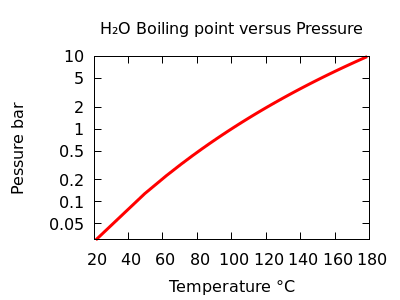
The above graph can't be extended endlessly.
First of all there is a lower limit. Decreasing the pressure also
decreases the boiling point. At some point the boiling point will be 0°C,
which is also the temperature at which water freezes. This is called the
triple point. Triple because at this point water can exist in three
forms: Solid (ice), liquid or gas. Or any combination thereof.
There is also an upper limit. As the temperature and pressure increase the
mean distance between the molecules decreases. At some point the density of
liquid and gas become identical. This is called the critical point.
In the diagram below a compressor pumps a refrigerant through a metal
(usually copper) pipe. At the inlet of the compressor the pressure is low.
At the outlet the pressure is high. The refrigerant flows through an
expansion valve which does exactly the opposite: It reduces the
pressure.
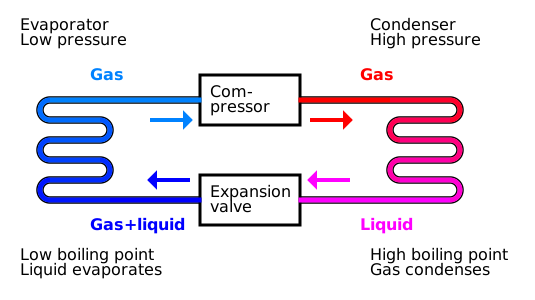
At the low pressure side the the boiling point is low which evaporates the
liquid. And since evaporation requires energy the pipe in which the
evaporation takes place cools off.
At the high pressure side the boiling point is high which condenses the
gas. And since condensation releases energy the pipe in which the
condensation takes place warms up.
At the cool side the pipe runs in a zigzag through thin metal plates. A fan
blows air between the plates which cools off the air. This bit is called
the evaporator.
At the warm side there is also a zigzag through thin metal plates. Here the
air blown between the plates gets warmed up. This part is called the
condenser.
Additional temperature differences are caused by the compressor and the
expansion valve;
Compression has the effect of increasing the temperature of the gas. (When
you inflate your tyres they actually get a tiny little bit warmer.) So the
gas that flows out of the
compressor is warmer than the
gas that flows into the
compressor. This additional heat is transferred to the air flowing through
the condenser.
And the reduction of pressure caused by expansion valve has the opposite
effect. The gas + liquid mix
that flows out of the expansion valve is cooler than the
liquid that flows into the
expansion valve.
So, to sum up;
- The compressor increases both pressure and temperature.
-
The condenser:
- Cools down the gas to boiling point.
- Condenses the gas into liquid.
- The expansion valve reduces both pressure and temperature.
- The condenser evaporates the liquid into gas, cooling the air that flows through it.
To make all of this work the air at the evaporator has to be warmer than the
evaporator itself and the air at the condenser has to be cooler than the
condenser. So the gas that flows
out of the evaporator is warmer then the
gas + liquid that flows into it.
And the liquid that flows out of
the condenser is cooler than the
gas that flows into the
condenser.
In principle, the lower the pressure in the evaporator and the higher the
pressure in the condenser the better this works. However, we don't want too
low a pressure in the evaporator because we need to stay away from the
triple point. After all, we don't want the refrigerant to freeze.
Furthermore air conditioners have their internal pressure always higher than
1 bar, even at the low pressure side. This way, if there is a small leak,
refrigerant leaks out, not air in. Air conditioners should only contain
refrigerant and not any air. (This is why they are pumped vacuum, before
they are filled with refrigerant.) So we need to use a refrigerant with a
very low boiling point at 1 bar.
The graph below shows how the boiling point of Difluoromethane (CH₂F₂),
a popular refrigerant also know as R32, changes with pressure:
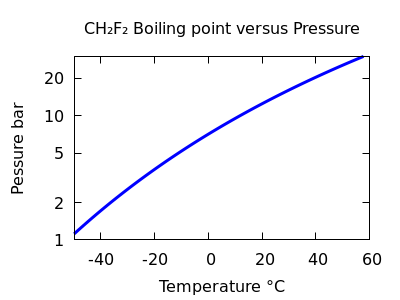
At 1 bar the boiling point is -52°C!
Sometimes other refrigerants are used, such as propane (R290) or isobutane
(R600a):
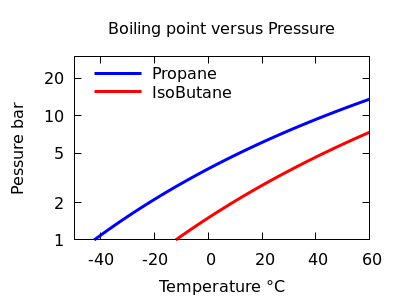
Due to the high flammability of propane and isobutane, these are only used
in very small systems, such as refrigerators.
An air conditioner has the evaporator indoor and the condenser outside.
A heat pump has the condenser indoor and the evaporator outside.
Most modern air conditioners have a system of valves which make it possible
to do both: With a button on the remote control you choose if the
evaporation takes place indoor and the condensation outside (cooling the
room) or the other way around (heating the room).
Links
Required cooling power
| Poorly insulated room | 50 Watt / m³ |
| Average insulated room | 40 Watt / m³ |
| Well insulated room | 30 Watt / m³ |
The above values are required cooling power, not the electrical power
consumption. And since 1 Watt equals 1 Joule per Second, the above numbers
are the the amount of heat (thermal energy) expressed in joules that is
removed from your room every second.
The actual electrical power consumption is much lower. The ratio between the
two determines the air conditioner efficiency:
                      Watts cooling power
 Efficiency = ────────────────────────────────────
               Watts electrical power consumption
As air conditioner technology improves, this number gets higher, which reduces your electricity bill. So you want this number to be as high as possible.
Theoretical efficiency
Below the theoretical maximum performance:
      Indoor temperature in Kelvin
 ────────────────────────────────────────
  Outside - Indoor temperature in Kelvin
And the same for degrees Celsius:
   Indoor °C + 273.15
 ────────────────────────
  Outside °C - Indoor °C
Below the theoretical maximum performance as a graph for a 24°C and a 27°C
indoor temperature:
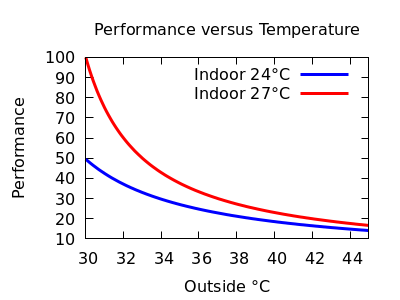
The actual efficiency is always less than this number and may be as small
as 1/10th of the theoretical maximum.
However, once your room is cool a modern air conditioner will reduce the
compressor speed and very little power is needed to keep it cool. This is
usually done by powering the compressor from a (three phase) inverter
(circuit which turns DC into AC): Reducing output frequency reduces the
compressor speed.
And the better the thermal insulation for your room, the less power your air
conditioner needs to keep it cool.
Units of measure
Non standard units.
Area vs Volume
Sometimes room sizes are expressed as m² instead of m³. This usually assumes a ceiling height of 2.6 m.
Calorie vs Joule
The Calorie is a unit of energy. The problem with the Calorie is, that it
isn't clearly defined: It's a bit like a measuring tape that expands and
contracts with changes in temperature. If you use this measuring tape the
measure things, the size of these things appear to change with temperature,
even when they don't.
A Calorie is mostly about 4.2 Joule:
| 1 Calorie | ≈ | 4.2 Joule |
| 1 Joule | ≈ | 0.24 Calorie |
The Calorie on Wikipedia: Calorie
KiloWattHour vs MegaJoule
This seems to confuse a lot of people.
The relationship between power en energy is similar to the relationship
between speed and distance:
          Distance
 Speed = ──────────
            Time

 Distance = Speed x Time
Likewise;
          Energy
 Power = ────────
           Time

 Energy = Power x Time
So
         Joules
 Watt = ─────────
         Seconds
And
Joules = Watt x Seconds
A hour equals 3600 seconds, so 1 kWh = 1000 Watt x 3600 Seconds = 3600000
Joules or 3.6 MegaJoule.
So that's multiplication, NOT
division: So it's NOT kiloWatt per hour!
('per' implies division.)
| 1 kWh | = | 3.6 MJ |
| 1 MJ | ≈ | 0.2778 kWh |
BTU/hour vs Watt
And yet an other
SI
vs imperial source of confusion!
A BTU or British Thermal Unit is 1055.1 Joule. And since one hour equals
3600 seconds, a BTU per hour is 1055.1 / 3600 ≈ 0.2931 Joules per Second
or Watt:
| 1 Watt | ≈ | 3.412 BTU/h |
| 1 BTU/h | ≈ | 0.2931 Watt |
A conversion table:
| BTU/h | kW |
|---|---|
| 9000 | 2.638 |
| 12000 | 3.517 |
| 15000 | 4.396 |
| 18000 | 5.275 |
| 24000 | 7.034 |
When the cooling power is expressed in BTU/h, this somehow is always a
whole multiple of 1000. My air conditioner for instance, is specified as
both 9000 BTU/h and 2.7 kW. And 3.412 x 2700 does not precisely equal
9000 (it's 9212.4). So these are rounded numbers!
Doing things this way may be more visually appealing, but doesn't provide
you with accurate information. So always look at the cooling power expressed
in kW.
Sometimes the air conditioner efficiency is expressed as BTU/h cooling
power / Watt power consumption (which equals BTU / Watt x hours). This gets
you a number that's a factor 3.412 higher than the above method, in which
case you have to divide the air conditioner efficiency value by 3.412 to get
a more realistic number.
Always make sure you're not dealing with inflated numbers!
Efficiency
Different ways to express how efficient an air conditioner is.
EER
Energy Efficiency Ratio
Efficiency measured with an outside temperature of 35°C and and an indoor
temperature of 27°C at 50% humidity.
COP
Coefficient Of Performance
This the the efficiency of a heat pump. And since most air conditioners
can also be used as a heat pump, COP is often specified as well.
SEER
Seasonal Energy Efficiency Ratio
This is more or less the average efficiency over a whole year; It's weighted
average efficiency that compensates for seasonal differences. You can think
of it as the total cooling provided in a whole year divided by the total
electricity consumption in a whole year.
In a modern air conditioner, this number tends to be a lot higher than EER.
| Outside temperature |
Weight factor |
|---|---|
| 35°C | 0.25 |
| 30°C | 0.25 |
| 25°C | 0.25 |
| 20°C | 0.25 |
The total SEER is the weighted sum of the EERs at the above values. So 1/4 of the EER at 35°C plus 1/4 of the EER at 30°C plus 1/4 of the EER at 25°C plus 1/4 of the EER at 20°C.
Some websites specify SEER in BTU/Wh instead of W/W (those inflated numbers again). Below a conversion table:
| BTU/Wh | W/W |
|---|---|
| 30 | 8.8 |
| 27 | 7.9 |
| 25 | 7.3 |
| 22 | 6.4 |
| 20 | 5.9 |
| 17 | 5.0 |
| 15 | 4.4 |
So, if somebody advertises a SEER of 20, it's probably BTU/Wh and not
W/W!
And from W/W to BTU/Wh:
| W/W | BTU/Wh |
|---|---|
| 8.5 | 29.0 |
| 6.1 | 20.8 |
| 5.6 | 19.1 |
| 5.1 | 17.4 |
| 4.6 | 15.7 |
SCOP
Seasonal Coefficient Of Performance
This is more or less the average efficiency of a heat pump over a whole
year; It's weighted average efficiency that compensates for seasonal
differences.
ESEER
European SEER:
| Load factor |
Outside temperature |
Weight factor |
|---|---|---|
| 100% | 35°C | 0.03 |
| 75% | 30°C | 0.31 |
| 50% | 25°C | 0.41 |
| 25% | 20°C | 0.23 |
EU Climate zones
Climates are different all over the world. This has led to plethora of different SEER and SCOP variants. The EU for instance, has SCOPs for different parts of Europe. One based on the weather in Helsinki, one for Strasbourg and one for Athens;
| Warm | Athens |
| Moderate | Strasbourg |
| Cold | Helsinki |
The idea is, that these SCOPs are valid for regions with a similar climate.
EU Energy Label
| Efficiency class |
SEER W/W |
|
|---|---|---|
| A+++ | ≥ 8.50 | |
| A++ | 6.10 - 8.49 | |
| A+ | 5.60 - 6.09 | |
| A | 5.10 - 5.59 | |
| B | 4.60 - 5.09 | |
Energy labels may get as low as 'G', but air conditioners with a label
below 'B' are not allowed.
I have never seen any air conditioners with a label below 'A' though. Most
are 'A+' or higher.
Note: Efficiency classes may change as regulation gets more strict!
Links
- Driving Efficiency Through Air Conditioning Assessments (PDF)
- European seasonal energy efficiency ratio
Noise
For comparison below some sound levels.
| dB | Noise |
|---|---|
| 10 | Normal breathing, A pin dropping |
| 20 | Rustling leaves |
| 30 | Whisper |
| 40 | A quiet residential area |
| 50 | Quiet Home, Light traffic |
| 60 | Normal conversation |
| 70 | Busy Restaurant, Shower |
Indoor units tend to be quieter than outdoor units.
And keep in mind that a fan sounds less annoying than a compressor.
You want your indoor unit to be very quiet. Especially if you want sleep
with the air conditioner on.
And the outdoor unit should be quiet too. After all, you don't want to
annoy the neighbours. People can be very envious of air conditioners. And
combined with noise pollution, this can mean serious trouble.